Important Questions for Physics Chapter 4 Moving Charges and Magnetism Class 12
Magnetic field lines can be entirely confined within the core of a toroid, but not within a straight solenoid. Why? (Delhi 2008)
Answer:
At the edges of the solenoid, the field lines get diverged due to other fields and/or non-availability of dipole loops, while in toroids the dipoles (in loops) orient continuously.
An electron does not suffer any deflection while passing through a region of uniform magnetic field. What is the direction of the magnetic field? (All India 2009)
Answer:

∴Magnetic field will be in the line of the velocity of electron.
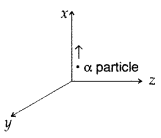
Question 3 Beam of particles projected along +x-axis, experiences a force due to a magnetic field along the +y-axis. What is the direction of the magnetic field? (All India 2009)
Answer: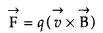
Direction of the magnetic field is towards negative direction of z-axis
Question 4
A beam of electrons projected along +x-axis, experiences a force due to a magnetic field along the +y/-axis. What is the direction of the magnetic field? (All India 2010)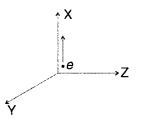
Answer:
Direction of the magnetic field is F = q (v × B) towards positive direction of z-axis
Question 5.
Depict the direction of the magnetic field lines due to a circular current carrying loop. (Comptt. Delhi 2012)
Answer:
Direction of the magnetic field lines is given by right hand thumb rule.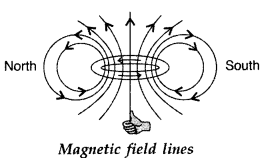
Question 6.
Why do the electric field lines not form closed loops? (Comptt. All India 2012)
Answer:
Electric field lines do not form closed loops because the direction of an electric field is from positive to negative charge. So one can regard a line of force starting from a positive charge and ending on a negative charge. This indicates that electric field lines do not form closed loops.
Question 7
Two charges of magnitudes – 2Q and + Q are located at points (a, 0) and (4a,0) respectively. What is the electric flux due to these charges through a sphere of radius ‘3a’ with its centre at the origin? (All India 2013)
Answer: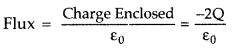
Question 8
Write the expression for the work done on an electric dipole of dipole moment p in turning it from its position of stable equilibrium to a position of unstable equilibrium in a uniform electric
field E. (Comptt. Delhi 2013)
Answer:
Torque, acting on the dipole is, τ = pE sin θ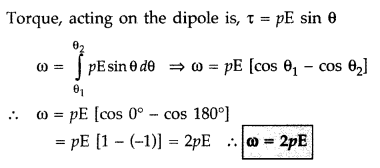
Question 9
Why do the electrostatic field lines not form closed loops? (All India 2014)
Answer:
Electric field lines do not form closed loops because the direction of an electric field is from positive to negative charge. So one can regard a line of force starting from a positive charge and ending on a negative charge. This indicates that electric field . lines do not form closed loops.
Question 10
Why do the electric field lines never cross each other? (All India)
Answer:
The electric lines of force give the direction of the electric field. In case, two lines of force intersect, there will be two directions of the electric field at the point of intersection, which is not possible.
Question 11.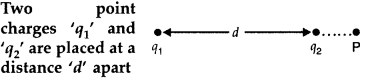
distance ‘d’ apart as shown in the figure. The electric field intensity is zero at a point ’P’ on the line joining them as shown. Write two conclusions that you can draw from this. (Comptt. Delhi 2014)
Answer:
- Two point charges ‘ q1‘ and ‘ q2 should be of opposite nature.
- Magnitude of charge ql must be greater than that of charge q2.
Question 12. What is the electric flux through a cube of side 1 cm which encloses an electric dipole? (Delhi 2015)
Answer:
Zero because the net charge of an electric dipole (+ q and – q) is zero.
Question 13.
Why are electric field lines perpendicular at a point on an equipotential surface of a conductor? (Comptt. All India 2015)
Answer:
If the electric field lines were not normal to the equipotential surface, it would have a non-zero component along the surface. To move a unit test charge against the direction of the component of the field, work would have to be done which means this surface cannot be equipotential surface.
Hence, electric field lines are perpendicular at a point on an equipotential surface of a conductor.
Question 14.
Is the potential difference VA – VB positive, negative or zero? (Delhi 2016)
Answer:
The potential difference is positive.
Question 15.
How does the electric flux due to a point charge enclosed by a spherical Gaussian surface get affected when its radius is increased? (Delhi 2016)
Answer:
The electric flux due to a point charge enclosed by a spherical gaussian surface remains ‘unaffected’ when its radius is increased.
Question 16.
Show on a plot the nature of variation of the
- Electric field (E) and
- potential (V), of a (small) electric dipole with the distance (r) of the field point from the centre of the dipole. (Comptt. Outside Delhi 2016)
Answer: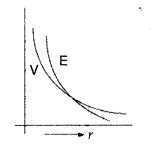
Question 17.
Does the charge given to a metallic sphere depend on whether it is hollow or solid? Give reason for your answer. (Delhi 2017)
Answer:
No, it does not, because the charge resides only on the surface of the conductor.
Question 18.
Draw a plot showing variation of electric field with distance from the centre of a solid conducting sphere of radius R, having a charge of +Q on its surface. (Comptt. Delhi 2017)
Answer:
Plot between E and r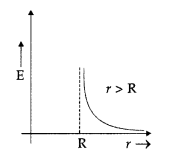
Question 19.
A point charge +Q is placed in the vicinity of a conducting surface. Draw the electric field lines between the surface and the charge.
(Comptt. Outside Delhi 2017)
Answer: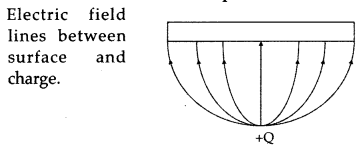
Question 20.
Derive an expression for the torque experienced by an electric dipole kept in a uniform electric field. (Delhi 2017)
Answer:
Consider an electric dipole consisting of charges + q and – q and of length 2a placed in a uniform electric field 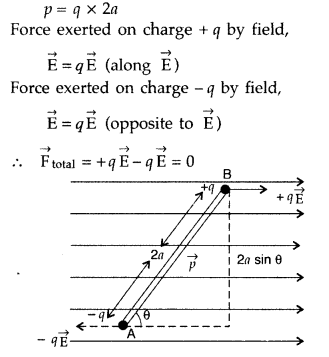
Question 21.
Define electric flux. Write its S.I. unit.
A charge q is enclosed by a spherical surface of radius R. If the radius is reduced to half, how would the electric flux through the surface change? (All India 2009)
Answer:
Electric flux over an area in an electric field is the total number of lines of force passing through the area. It is represented by ϕ . It is a scalar quantity. Its S.I unit is Nm2 C-1 or Vm.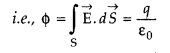
Electric flux ϕ by qenclosed
Hence the electric flux through the surface of sphere remains same.
Question 22.
A spherical conducting shell of inner radius rx and outer radius r2 has a charge ‘Q’. A charge ‘q’ is placed at the centre of the shell.
(a) What is the surface charge density on the
(i) inner surface,
(ii) outer surface of the shell?
(b) Write the expression for the electric field at a point x > r2 from the centre of the shell. (All India 2010)
Answer:
(a) Surface charge density on the :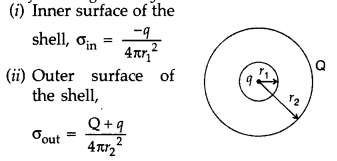
(b) Electric field at a point x > r2 from the centre of the shell will be E =
Question 23.
Show that the electric field at the surface of a charged conductor is given by
Answer:
Electric field at a point on the surface of charged conductor, E =
For simplicity we consider charged conductor as a sphere of radius ‘R’. If ‘σ’ is in surface charge density, then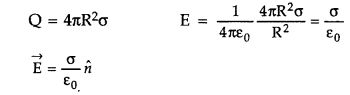
…where [
Question 24.
A thin straight infinitely long conducting wire having charge density X is enclosed by a cylindrical surface of radius r and length l, its axis coinciding with the length of the wire. Find the expression for the electric flux through the surface of the cylinder. (All India 2011)
Answer:
Since the field is everywhere radial, flux through the two ends of the cylindrical Gaussian surface is zero. At the cylindrical part of the surface, E is normal to the surface at every point, and its magnitude is constant, since it depends only on r. The surface area of the curved part is 2πrl, where l is the length of the cylinder.
Hence the net translating force on a dipole in a uniform electric field is zero. But the two equal and opposite forces act at different points of the dipole. They form a couple which exerts a torque.
Torque = Either force × Perpendicular distance between the two forces
x = qE × 2a sin θ
X = pE sin θ [ ∵ p = q × 2a; p is dipole moment]
As the direction of torque
Flux through the Gaussian surface = Flux through the curved cylindrical part of the surface is zero. At the cylindrical part of the surface, E is normal to the surface at every point, and its magnitude is constant, since at every point, and its magnitude is constant, since it depends only on r. The surface area of the cylinder.
Flux through the Gaussian surface = Flux through the curved cylindrical part of the surface
= E × 2πrl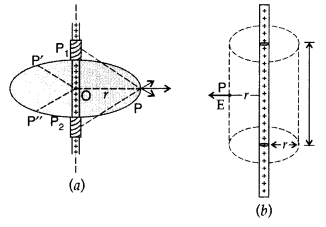
(a) Electric field due to an infinitely long thin straight wire is radial.
(b) The Gaussian surface for a long thin wire of uniform linear charge density
The surface includes charge equal to λl.
Gauss’s law then gives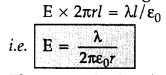
Question 25.
Plot a graph showing the variation of coulomb force (F) versus
Answer: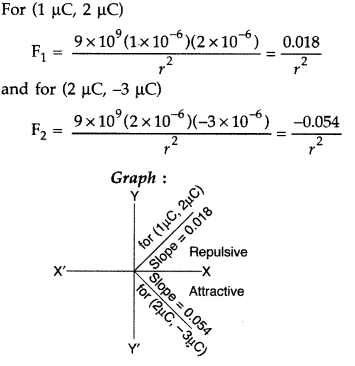
Here positive slope depicts that force is repulsive in nature and negative slope depicts that the force is attractive in nature.

No comments:
Post a Comment