BOARD BREAKER : ELECTRICITY'S MUST KNOW QUESTIONS
MOST EXPECTED BOARD QUESTIONS
CLASS 10
SCIENCE
Question 1
A piece of wire of resistance R is cut into five equal parts. These parts are then connected in parallel. If the equivalent resistance of this combination is R’, then the ratio R/R’ is :(a)
(b)
(c) 5
(d) 25
Answer:
(d) 25
Which of the following terms does not represent electrical power in a circuit?
(a) I2R
(b) IR2
(c) VI
(d)
Answer:
(fa) IR2
An electric bulb is rated 220 V and 100 W. When it is operated on 110 V, the power consumed will be :
(a) 100 W
(b) 75 W
(c) 50 W
(d) 25 W
Answer:
(d) 25 W
Two conducting wires of the same material and of equal lengths and equal diameters are first connected in series and then parallel in a circuit across the same potential difference. The ratio of heat produced in series and parallel combinations would be :
(a) 1 : 2
(b) 2 : 1
(c) 1 : 4
(d) 4 : 1
Answer:
(c) 1 : 4
Answer:

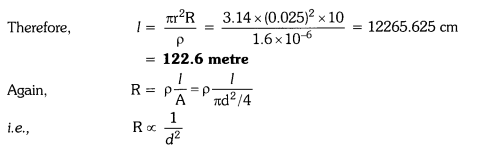
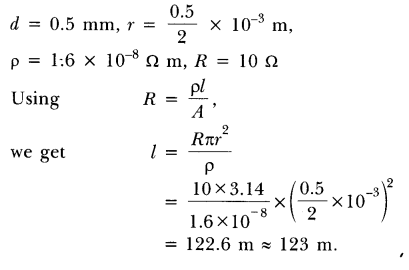
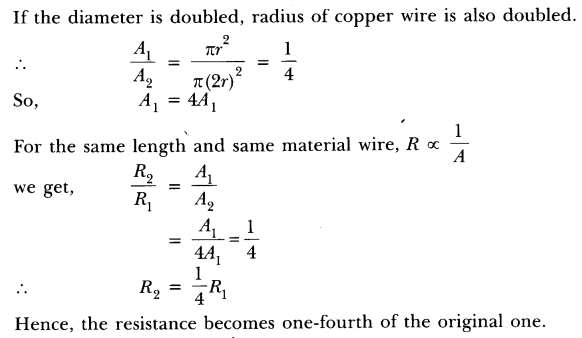
If a wire of diameter doubled to it is taken, then area of cross-section becomes four times.
New resistance =
Decrease in resistance = (10 – 2.5) Ω = 7.5 Ω

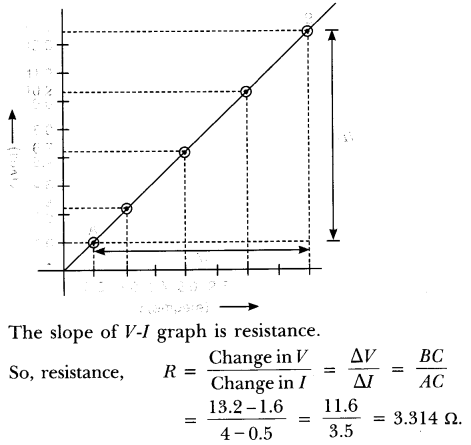
Plot a graph between V and I and calculate the resistance of the resistor.
Solution:
The graph between V and I for the above data is given below.
The slope of the graph will give the value of resistance.
Let us consider two points P and Q on the graph.
and from P along Y-axis, which meet at point R.
Now, QR = 10.2V – 34V = 6.8V
And PR = 3 – 1 = 2 ampere
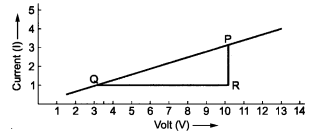

Thus, resistance, R = 3.4 Ω
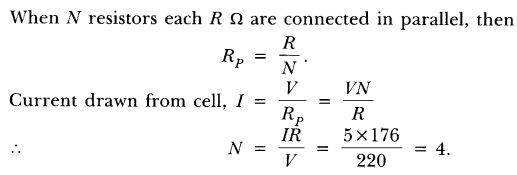
Suppose n resistors of 176 Ω are connected in parallel.
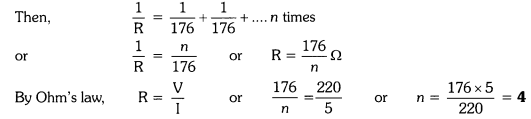
Thus 4 resistors are needed to be connect
Solution:
Here, current, I = 5 A, voltage, V = 220 V
∴ Maxium power, P = I x V = 5 x 220 = 1100W
Required no. of lamps
∴ 110 lamps can be connected in parallel.
Solution:
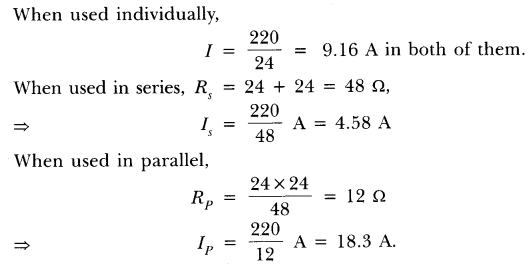
(i) When the two coils A and B are used separately. R = 24 Ω, V = 220 V
(ii) When the two coils are connected in series,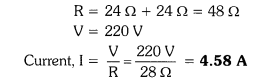
(iii) When the two coils are connected in parallel.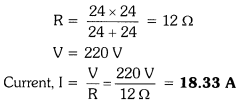
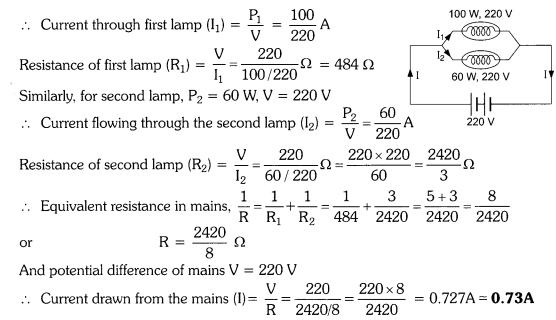
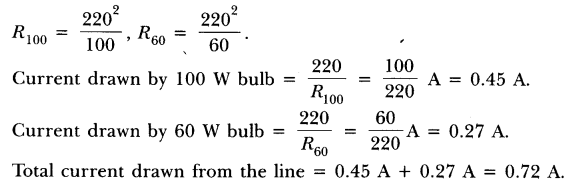
10. Two lamps, one rated 100 W at 220 V, and the other 60 W at 220 V, are connected in parallel to electric mains supply. What current is drawn from the line if the supply voltage is 220 V ? [CBSE 2018]
Solution:Power of first lamp (P1) = 100 W
Potential difference (V) = 220 V
Solution:
Energy used by 250 W TV set in 1 hour = 250 W x 1 h = 250 Wh
Energy used by 1200 W toaster in 10 minutes = 1200 W x 10 min
= 1200 x
Thus, the TV set uses more energy than the toaster.
Question 12
An electric heater of resistance 8 Ω draws 15 A from the service mains 2 hours. Calculate the rate at which heat is developed in the heater.
Solution:
Here, R = 8 Ω, 1 = 15 A, t = 2 h
The rate at which heat is developed in the heater is equal to the power.
Therefore, P = I2 R = (15)2 x 8 = 1800 Js-1
13. Explain the following:
(i) Why is tungsten used almost exclusively for filament of electric lamps ?(ii) Why are the conductors of electric heating devices, such as bread-toasters and electric irons, made of an alloy rather than a pure metal ?
(in) Why is the series arrangement not used for domestic circuits ?
(iv) How does the resistance of a wire vary with its area of cross-section ?
(v) Why are copper and aluminium wires usually employed for electricity transmission?
Answer:
(i) The tungsten is used almost exclusively for filament of electric lamps because it has a very high melting point (3300°C). On passing electricity through tungsten filament, its temperature reaches to 2700°C and it gives heat and light energy without being melted.
(ii) The conductors of electric heating devices such as bread-toasters and electric irons, are made of an alloy rather than a pure metal because the resistivity of an alloy is much higher than that of pure metal and an alloy does not undergo oxidation (or burn) easily even at high temperature.
(iii) The series arrangement is not used for domestic circuits because in series circuit, if one electrical appliance stops working due to some defect, than all other appliances also stop working because the whole circuit is broken.
(iv) The resistance of a wire is inversely proportional to its area of cross-section, i.e., Resistance R ∝ (1/πr2). If the area of cross section of a conductor of fixed length is increased, then resistance decreases because there are more free electrons for movement in conductor.
(v) Copper and aluminium wires usually employed for electricity transmission because they have very low resistances. So, they do not become too hot on passing electric current.
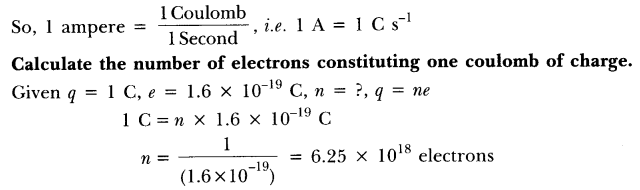
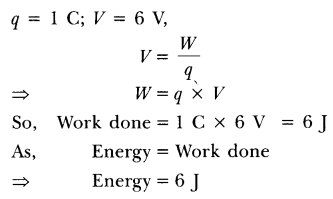
Define the unit of current.
SI unit of electric current is ampere (A).
Ampere is the flow of electric charges through an area at the rate of one coulomb per second, i.e. if 1 coulomb of electric charge flows through a cross-section of wire for 1 second, then it would be equal to 1 ampere.
Answer:
Advantages of connecting electrical devices in parallel:
- When the appliances are connected in parallel with the battery, each appliance gets the same potential difference as that-of battery which is not possible in series connection.
- Each appliance has different resistances and requires different currents to operate properly. This is possible only in parallel connection, as in series connection, same current flows through all devices, irrespective of their resistances.
- If one appliance fails to work, other will continue to work properly.
(a) The highest resistance is secured by combining all four coils of resistance in series.
Rs = 4 Ω+ 8 Ω + 12 Ω + 24 Ω = 48 Ω
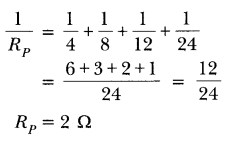
(b) The lowest resistance is secured by combining all four coils of resistance in parallel.

Plot a graph between V and I and calculate the resistance of that resistor.
Answer:
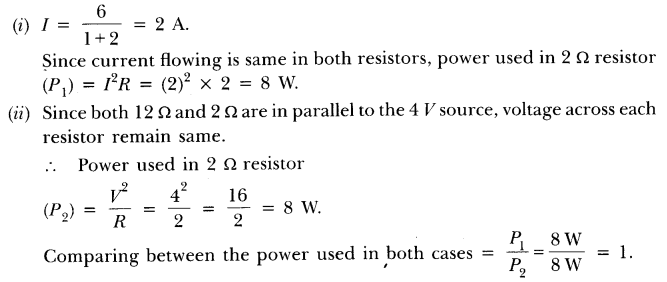
Since all the resistors are in series, the same current, 0.67 A flows through the 12 Ω resistor.

(ii) a 4 V battery in parallel with 12 Ω and 2 Ω resistors.
Answer:
Answer:
Energy consumed by 250 W TV set in 1 h = 250 x 1 = 250 Wh.
Energy consumed by 1200 W toaster in 10 min = 1200 X 1/6 = 200 Wh.
∴ Energy consumed by TV set is more than the energy consumed by toaster in the given timings.
Question 26:
An electric heater of resistance 8 f2 draws 15 A from the service mains 2 hours. Calculate the rate at which heat is developed in the heater.
Answer: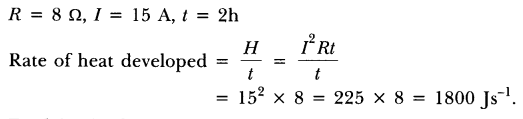
27.hree 2 Ω resistors, A, B and C are connected as shown in figure. Each of them dissipates energy and can withstand a maximum power of 18 W without melting. Find the maximum current that can flow through the three resistors.
Answer: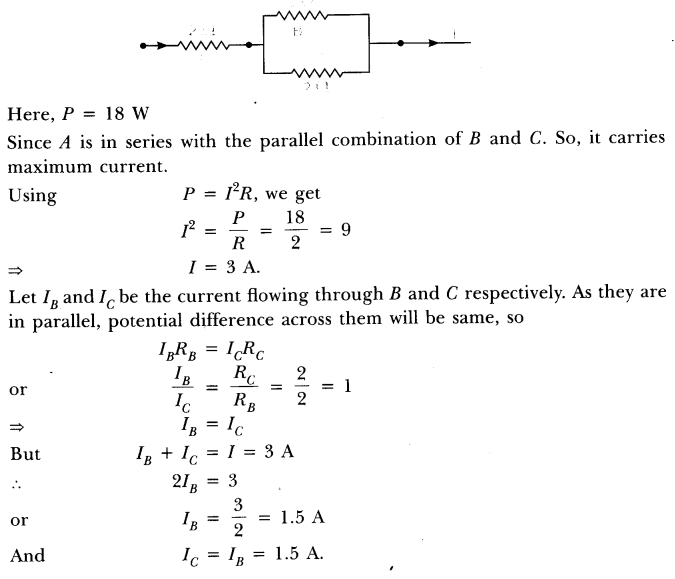
Answer:
The resistance of an ammeter should be low so that it will not disturb the magnitude of current flowing through the circuit when connected in series in a circuit.
Question 29:
How does use of a fuse wire protect electrical appliances?
Answer:
The fuse wire is always connected in series with the live wire or electrical devices. If the flow of current exceeds the specified preset value due to some reason, the heat produced melts it and disconnects the circuit or the device from the mains. In this way, fuse wire protects the electrical appliances.
Question 30:
What is electrical resistivity? In a series electrical circuit comprising a resistor made up of a metallic wire, the ammeter reads 5 A. The reading of the ammeter decreases to half when the length of the wire is doubled. Why?
Answer:
The resistance offered by a metallic wire of unit length and unit cross-sectional area is called electrical resistivity.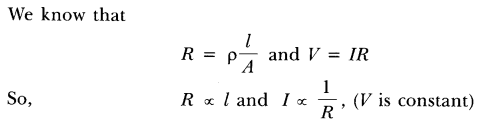

No comments:
Post a Comment