REFRACTIVE INDEX
CLASS 10
IMPORTANT QUESTIONS FOR BOARD EXAM
1. The absolute refractive indices of glass and water are 4/3 and 3/2 respectively. If the speed of light in glass is 2 × 10⁸ m/s, calculate the speed of light in (i) vacuum, (ii) water. (AI 2015)

Answer:
Given : refractive index of glass, ng = 1.5
Refractive index of water, nw = 1.33
Since, refractive index of medium,

Dividing (i) by (ii),


According to Snell’s law,
∴ sin i = 1.0225 × sin r
(a) Laws of refraction of light:
(i) The incident ray, the refracted ray and the normal to the interface of two transparent media at the point of incidence, all lie in the same plane.
(ii) The ratio of sine of angle of incidence to the sine of the angle of refraction is constant, for the light of a given colour and for the given pair of media.
This law is also known as Snell’s law of refraction.
where i is the angle of incidence and r is the angle of refraction.
This constant value is called refractive index of the second medium with respect to the first when the light travels from first medium to second medium.
⇒ constant = n21 =
If n is the absolute refractive index of the medium, c is the velocity of light in vacuum and v is the speed of light in a given medium, then n = cl v.
5. What is meant by power of a lens? Write its SI unit. A student uses a lens of focal length 40 cm and another of -20 cm. Write the nature and power of each lens. (2018)
Answer:
Refer to answer 65.
Given that: Focal length of lens A, fA = +40 cm
Focal length of lens B, fB = -20 cm
Lens A is converging. Lens B is diverging.

Magnification of -1 indicates that the image is real and inverted and is of the same size as of the object. The object must be at 2f and image also at 2f on the other side.
Total distance between image and object
Also 4f = 60 cm ⇒ f = 15 cm
If object is moved 20 cm towards the lens, then the object will be between focus and optical centre of the lens and image formed will be virtual and erect and on the same side of the lens.

7. If the image formed by a lens for all positions of the object placed in front of it is always virtual, erect and diminished, state the type of the lens. Draw a ray diagram in support of your answer. If the numerical value of focal length of such a lens is 20 cm, find its power in new cartesian sign conventions. (Foreign 2016)
Answer:
Concave lens always forms virtual, erect and diminished image for all positions of the object.

Focal length of the concave lens
f = -20 cm =
Power of the lens, P =
8. State the laws of refraction of light. If the speed of light in vacuum is 3 × 10⁸ m/s, find the absolute refractive index of a medium in which light travels with a speed of 1.4 × 10⁸ m/s. (Foreign 2015)
Answer:
Laws of refraction: Refer to answer 74.
The speed of light in vacuum = 3 × 10⁸ m/s
The speed of light in a medium = 1.4 × 10⁸ m/s
∴ Absolute refractive index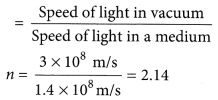
9. State the laws of refraction of light. If the speed of light in vacuum is 3 × 10⁸ m s-1, find the speed of light in a medium of absolute refractive index 1.5. (Delhi 2014, AI 2014)
Answer:
Refer to answer 74.
The speed of light in vacuum = 3 × 10⁸ m/s
Absolute refractive index =1.5
∴ The speed of light in a medium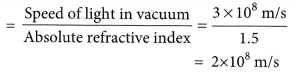
10. At what distance from a concave lens of focal length 25 cm a 10 cm tall object be placed so as to obtain its image at 20 cm from the lens. Also calculate the size of the image formed. Draw a ray diagram to justify your answer for the above situation and label it. (Foreign 2016)
Answer:
Focal length of concave lens f = – 25 cm
Image distance, v = -20 cm
Height of the object, h = 10 cm
Now, from lens formula,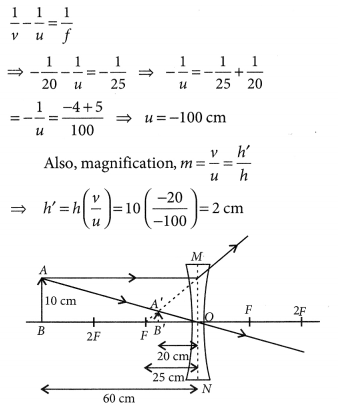
11. (a) State the laws of refraction of light. Explain the term absolute refractive index of a medium and write an expression to relate it with the speed of light in vacuum.
(b) The absolute refractive indices of two media A and B are 2.0 and 1.5 respectively. If the speed of light in medium B is 2 × 10⁸ m/s, calculate the speed of light in
(i) vacuum
(ii) medium A (Delhi 2015)
Answer:
(a) Refer to answer 74.
(b) Given that nA = 2.0, nA = 1.5, vA = 2 × 10⁸ m/s
(i) nB = 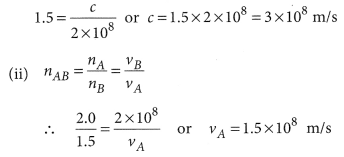
(b) State and define the S.I unit of power of a lens.
(c) A convex lens of focal length 25 cm and a concave lens of focal length 10 cm are placed in close contact with each other. Calculate the lens power of this combination. (AI 2011)
Answer:
(a) Refer to answer 63.
(b) Refer to answer 65.
(c) Power of convex lens of focal length 25 cm is
p1 =
Power of concave lens of focal length 10 cm is 100
p2 =
∴ Power of the combination = P = P1 + P2
∴ P = 4 – 10 = -6D
Answer:
Refer to answer 65.
Given that:
Focal length of lens A, fA = +10 cm
Focal length of lens B, fB = -10 cm
Lens A is convex lens . Lens B is concave lens,
Power of lens A =
Power of lens B =
Lens A will form a virtual and magnified image.
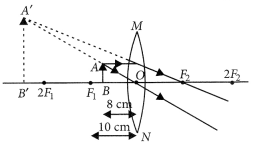
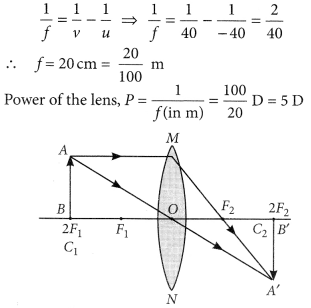
14. What is meant by the power of a lens ? What is its S.I. unit ? Name the type of lens whose power is positive. The image of an object formed by a lens is real, inverted and of the same size as the object. If the image is at a distance of 40 cm from the lens, what is the nature and power of the lens? Draw ray diagram to justify your answer. (Foreign 2015)
Answer:Convex lens has positive power. Since the image of an object formed by a lens is real, inverted and of the same size as the object.
Given: Size of object = Size of image and h’ = -h
∴ Magnification, m =
∴ -1 =
Focal length of the lens,
Answer:
(i) Convex mirror is used as rear view mirror because
(a) it gives erect image.
(b) it gives diminished image thus provides wider view of traffic behind the vehicle.
(ii) Concave mirror is used as shaving mirror because
(a) it gives erect image when mirror is close to the face.
(b) it gives enlarged image of the face so that a person can shave safely.

👍
ReplyDelete