Important Questions of Metals and Non-Metals Class 10 Science Chapter 3
Reverse of the following chemical reaction is not possible:
Zn(s) + CuSO4(aq) → ZnSO4(aq) + Cu(s)
Justify this statement with reason. (Board Term I, 2016)
Answer:
If a strip of zinc metal is put in copper sulphate solution, then the blue colour of copper sulphate fades gradually due to the formation of colourless zinc sulphate solution and reddish-brown copper metal is deposited on zinc strip.


(b) has a very low melting point.
(c) does not react with oxygen even at high temperature.
(d) is most ductile. (Board Term I, 2015)
Answer:
(a) Metal which is the best conductor of heat is silver.
(b) Gallium has a very low melting point.
(c) Silver and gold do not react with oxygen even at high temperature.
(d) Gold is the most ductile metal.
Na2O, ZnO, CO2, Al2O3, H2O (Board Term I, 2014)
Answer:
Amphoteric oxides are those which show acidic as well as basic character, i.e., they react with bases as well as acids. ZnO and Al2O3 are amphoteric oxides
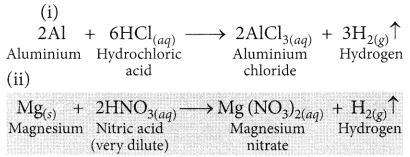
(i) Al + HCl →
(ii) Mg + HNO3 →
Answer:
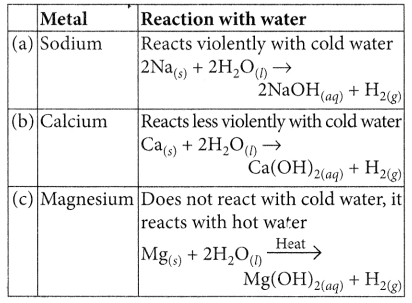
(a) Sodium
(b) Calcium
(c) Magnesium
Answer:
(i) Hydrogen gas is not evolved when most of the metals react with nitric acid.
(ii) Zinc oxide is considered as an amphoteric oxide.
(iii) Metals conduct electricity. (Board Term I, 2016)
Answer:
(i) Hydrogen gas is not evolved when most metals react with nitric acid. It is because HNO3 is a strong oxidising agent. It oxidises the H2 produced to water and itself gets reduced to any of the nitrogen oxides (N2O, NO, NO2).
(ii) ZnO reacts both with acids as well as bases to form salt and water. Thus, ZnO is an amphoteric oxide.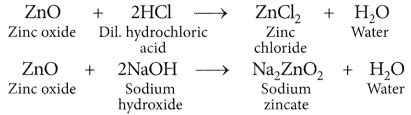
(iii) Metals conduct electricity due to the flow of free electrons present in them.
7. (a) Why does calcium start floating when it reacts with water? Write the balanced chemical equation of the reaction.
(b) Name two metals which do not react with water. (Board Term I, 2015)
Answer:
(a) Calcium reacts with cold water to form calcium hydroxide and hydrogen gas.
The bubbles of hydrogen gas produced stick to the surface of calcium and hence, it starts floating on the surface of water.
(b) Gold and silver do not react with water.
(b) Calcium starts floating when water is added to it. (Board Term I, 2014)
Answer:
(a) Aluminium is a strong and cheap metal. It is also a good conductor of heat. But it is highly reactive. When it is exposed to moist air, its surface is covered with a thin impervious layer of aluminium oxide (Al2O3). This layer does not allow moist air to come in contact with the fresh metal and hence, protects the metal underneath from further damage or corrosion. Thus, after the formation of this protective layer of Al2O3, aluminium becomes resistant to corrosion. It is because of this reason that although aluminium is a highly reactive metal, it is still used in food packaging.
9. (a) Complete and balance the following chemical equations:
(i) Al2O3 + HCl →
(ii) K2O + H2O →
(iii) Fe + H2O →
(b) An element ‘X’ displaces iron from the aqueous solution of iron sulphate. List your observations if the element ‘X’ is treated with the aqueous solutions of copper sulphate, zinc sulphate and silver nitrate. Based on the observations arrange X, Zn, Cu and Ag in increasing order of their reactivities. (2020)
Answer:
(a) (i) Al2O3 + 6HCl → 2AlCl3 + 3H2O
(ii) K2O + H2O → 2KOH
(iii) 3Fe + 4H2O → Fe3O4 + 4H2
(b) As X displaces iron from its salt solution hence X is more reactive than iron. It will also displace copper from copper sulphate and silver from silver nitrate as both are less reactive than iron. As zinc is more reactive than iron hence, X can be more or less reactive than zinc. Then the order of their reactivities can be
Ag < Cu < Fe < Zn < X or Ag < Cu < Fe < X < Zn.
10. A metal ‘X’ combines with a non-metal ‘Y’ by the transfer of electrons to form a compound Z.
(i) State the type of bond in compound Z.
(ii) What can you say about the melting point and boiling point of compound Z?
(iii) Will this compound dissolve in kerosene or petrol?(iv) Will this compound be a good conductor of electricity? (Board Term I, 2017)
Answer:
X being a metal loses electrons and Y being a non-metal gains electrons to form Z.
(i) The chemical bond formed by the transfer of electrons from one atom to another is known as an ionic bond. Hence, Z is an ionic compound.
(ii) Compound Z is an ionic compound thus, it has high melting and boiling points.
(iii) Ionic compounds are insoluble in non-polar solvents such as kerosene or petrol.
(iv) As Z is an ionic compound, it does not conduct electricity in the solid state because movement of ions in the solid is not possible due to their rigid structure. But it conducts electricity in the molten state or in aqueous solution due to the movement of ions freely.
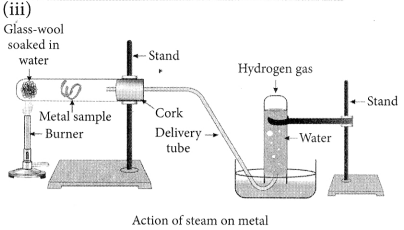
(iii) With the help of a labelled diagram show the experimental set up of action of steam on a metal. (2020)
Answer:
(ii) Ionic compounds are solids because the particles which make up ionic compounds are held together by strong electrostatic bonds.
(iii) Name two metals which melt when you keep them on your palm.
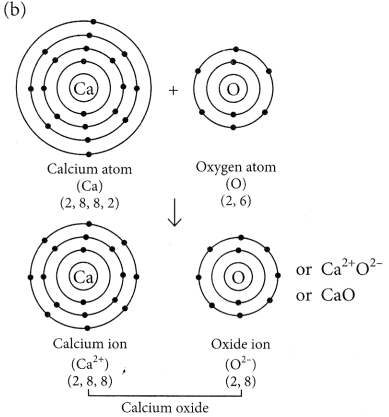
(b) Explain the formation of ionic compound CaO with electron-dot structure. Atomic numbers of calcium and oxygen are 20 and 8 respectively. (2020)
Answer:
(a) (i) The malleability and ductility properties of gold make it suitable for ornaments.
(ii) Silver and gold.
(iii) Gallium and caesium have so low melting points that they melt even on keeping them on palm.
13. (i) Write down the electronic configuration
of magnesium and oxygen.
(ii) Give two general properties of the compound formed by combination of magnesium and oxygen.
(iii) Show the formation of this compound by the transfer of electrons. (Board Term 1,2014)
Answer:
(i) Atomic number of magnesium (Mg) = 12
∴ Its electronic configuration = 2, 8, 2
Atomic number of oxygen = 8
Electronic configuration of oxygen = 2, 6
(ii) Magnesium (Mg) reacts with oxygen (O2) to form magnesium oxide (MgO).
2Mg + O2 → 2MgO
Properties of MgO are :
(a) It involves ionic bonding.
(b) It has high melting point due to strong electrostatic forces of attraction between Mg2+ and O2- ions.
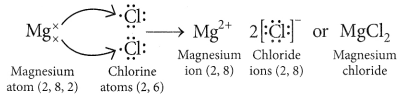
(iii) In the formation of magnesium oxide, two electrons are transferred from magnesium atom to oxygen atom as represented :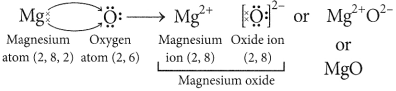
14. An ore on treatment with dilute hydrochloric acid produces brisk effervescence. Name the type of ore with one example. What steps will be required to obtain metal from the enriched ore? Also write the chemical equations for the reactions involved in the process. (AI 2019)
Answer:
The ore on treatment with dilute hydrochloric acid produces brisk effervescence hence, it must be a carbonate ore. Calamine (ZnCO3) is an important carbonate ore of zinc.
Steps required to obtain metal from the enriched carbonate Are:
(a) Conversion of the carbonate ore into metal oxide : This is done by calcination (for carbonate ores).
Calcination is the process of heating the ore strongly in the absence or limited supply of air. The zinc carbonate on heating decomposes to form zinc oxide as shown :
(b) Reduction of the metal oxide to metal : As zinc is moderately reactive, zinc oxide cannot be reduced by heating alone. Hence, it is reduced to zinc by using a reducing agent such as carbon.
The reduction of metal oxides by heating with coke is called smelting
15. (i) Carbonate of metal ‘2T is abundant in earth crust and its hydroxide is used in ‘white washing’. Identify metal ‘XI
(ii) How will you convert this carbonate into its oxide? Name the process and write its equation. (Board Term I, 2014)Answer:
(i) Calcium carbonate is abundant in earth’s crust and calcium hydroxide is used in white washing. Hence, metal X is calcium (Ca).
(ii) CaCO3 is strongly heated in the absence of air to get the metal oxide. This process is called calcination.

Sodium, magnesium and aluminium have higher affinity towards oxygen than that of carbon because these are highly reactive metals. Hence, carbon cannot reduce the oxides of sodium, magnesium and aluminium to their respective metals. These metals are placed at the top of the reactivity series. The highly reactive metals like Na, Mg, Al, etc. are extracted by electrolytic reduction of their molten chlorides or oxides. Electrolytic reduction is brought about by passing electric current through the molten state. Metal gets deposited at the cathode.
NaCl ⇌ Na+ + Cl–
At cathode : Na+ + e– → Na
At anode : 2Cl– → Cl2 + 2e–
(b) How is copper extracted from its sulphide ore? Explain the various steps supported by chemical equations. Draw labelled diagram for the electrolytic refining of copper. (2018)
Answer:
(a) Extraction of metals of medium reactivity:
The metals in the middle of the reactivity series are zinc, iron, lead, etc. The carbonate ores first need to get converted to oxides as it is easier to get metal from their oxides.
Refer to answer 15.
(b) Copper glance (Cu2S) when heated in air gets partially oxidised to copper oxide which further reacts with the remaining copper glance to give copper metal.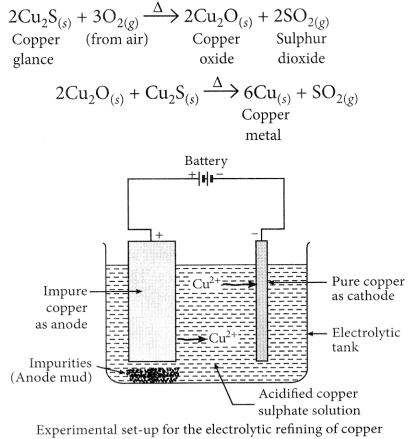
18. (a) Describe an activity to show that metals are good conductors of electricity.
(b) Account for the following :(i) Hydrogen gas is not evolved when a metal reacts with nitric acid.
(ii) For storing sodium metal, it is kept immersed in kerosene.
(iii) The reaction of iron (III) oxide with aluminium is used to join cracked iron parts of machines. (Board Term I, 2016)
Answer:
(a) Activity : (i) Set up an electric circuit as shown in the figure.
(ii) Place the metal to be tested (Cu, Al, Ag, Fe, etc.) in the circuit, between the terminal A and B.
(iii) Switch on the battery.
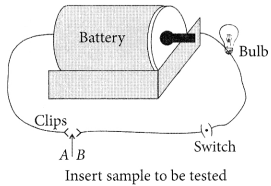
Conclusion : This indicates that the current is flowing through the metal wire. Hence, metals are good conductors of electricity.
Reason (R) : Bronze is an alloy of copper and tin and it is not a good conductor of electricity.
(a) Both (A) and (R) are true and (R) is the correct explanation of the assertion (A).
(b) Both (A) and (R) are true, but (R) is not the correct explanation of the assertion (A).
(c) (A) is true, but (R) is false.
(d) (A) is false, but (R) is true.
Answer:
(c) : Metals and alloys have free electrons in them which can move freely inside them, so they conduct electricity very easily. Bronze is an alloy of copper and tin and it is a very good conductor of electricity.
Answer:
When a metal has been kept exposed to air for a long time, then it gets a dull appearance. The metals lose their shine or brightness due to the formation of a thin layer of oxide, carbonate or sulphide on their surface and thus, the metal surface gets corroded. The surface of copper gets coated with a green layer in moist air due to the formation of basic copper carbonate, silver articles acquire a blackish tinge due to the formation of silver sulphide
(i) Metal that can be cut by knife
(ii) Lustrous non-metal
(iii) Metal that exists in liquid state at room temperature
(iv) Most malleable and ductile metal
(v) Metal that is best conductor of electricity
(vi) Non-metal that can exist in different forms
(b) How are alloys better than metals? Give composition of solder and amalgam.
Answer:
(a) (i) Sodium
(ii) Iodine
(iii) Mercury
(iv) Gold
(v) Silver
(vi) Carbon
(b) Alloys are stronger than the metals from which they are made, more resistant to corrosion, have lower melting point, have lower electrical conductivity. Solder is an alloy of lead and tin. An amalgam is an alloy of mercury with another metal.
22. (a) Define corrosion.
(b) What is corrosion of iron called?(c) How will you recognise the corrosion of silver?
(d) Why corrosion of iron is a serious problem?
(e) How can we prevent corrosion of iron? (Board Term I, 2017)
Answer:
(a) The process of slowly eating up of metals due to their conversion into oxides, carbonates, sulphides, etc., by the action of atmospheric gases and moisture is called corrosion.
(b) The corrosion of iron is called rusting.
(c) Silver articles become black after sometime when exposed to air. This is due to formation of a coating of black silver sulphide (Ag2S) on its surface by the action of H2S gas present in the air.
(d) Corrosion of iron is a serious problem. Every year large amount of money is spent to replace damaged iron articles. Corrosion causes damage to car bodies, bridges and iron railings, ships and to all objects made of metals specially those of iron.
(e) Corrosion of iron is prevented by coating it with a layer of oil. The reason being that the layer of oil does not allow air and water to react the surface of iron. Corrosion of iron can also be prevented by painting, greasing, galvanising, anodising, electroplating or making alloys
(a) A metal, which is preserved in kerosene.
(b) A lustrous coloured non-metal.
(c) A metal, which can melt while kept on palm.
(d) A metal, which is a poor conductor of heat.
Answer.
(a) Sodium is preserved in kerosene.
(b) Iodine is lustrous coloured non-metal.
(c) Gallium. ‘
(d) Lead.
(i) Identify the metal ‘X’ and name the process responsible for this change.
(ii)Name and write chemical formula of the green coating formed on the metal.
(iii) List two important methods to prevent the process.
Answer.
(i) Metal is copper. The process is corrosion.
(ii)Basic copper carbonate [CuCO3.Cu(0H)2].
(iii)
• It should be coated with tin
• It should be mixed with other metals to form alloys.
Na2O, ZnO, Al2O3, CO2, H2O
Answer.Those oxides which reacts with acids as well as bases to produce salts and water are called amphoteric oxides, e.g. Na2O, ZnO, are amphoteric oxides among given oxides.
(b) Explain what is galvanisation. What purpose is served by it?
(c) Define an alloy. How are alloys prepared? How do the properties of iron change when:
(i) small quantity of carbon,
(ii) nickel and chromium are mixed with it.
Answer.
(a) Ag2S (silver sulphide) is formed on silver, basic copper carbonate CuCO3. CU(OH)2 is formed on copper.
(b) The process of coating zinc over iron is called galvanisation. It is used to prevent rusting of iron.
(c) Alloy is a homogeneous mixture of two or more metals. One of them can be non-metal. Alloys are prepared by melting two or more metals together.
(?) Iron does not rust on adding small,quantity of carbon.
(ii) When we form alloy of iron with nickel and chromium, we get stainless steel which is malleable and does not get rusted.
(b) How is sodium obtained from molten sodium chloride? Give equation of the reactions.
(c) How is copper obtained from its sulphide ore? Give equations of the reactions.
Answer.
(a) It is because ‘Mg’ is stronger reducing agent than carbon.
(b) Sodium is obtained from molten NaCl by electrolysis.
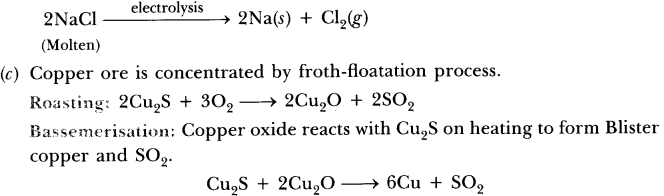
Blister Copper is purified by electrolytic refining.
(i) Silver and copper lose their shine when they are exposed to air. Name the substance formed on their surface in each case.
(ii) Tarnished copper vessels are cleaned with tamarind juice.
(iii) Aluminium is more reactive than iron yet there is less corrosion of aluminium as compared to iron when both are exposed to air.
Answer.
(i) These metals get corroded. Silver forms black Ag2S (silver sulphide) and copper form greenish layer of basic copper carbonate CuCO3. CU(OH)2 .
(ii) Tamarind contains acid which reacts with basic copper carbonate and product gets dissolved and removed from copper vessel.
(in) Aluminium forms oxide layer on its surface which does not further react with air.
29. What are alloys? How are they made? Name the constituents and uses of brass, bronze and solder.
Answer. Alloys are homogeneous mixtures of two or more metals. One of them can be a non-metal also. They are made by melting a metal which is in large amount first and then adding the other metal. ,
Brass contains copper and zinc. It is used for making decorative articles. Bronze contains copper and tin. It is used for making statues and medals. Solder contains lead and tin. It is used for soldering purposes.
30. . A non-metal X exists in two different forms Y and Z. Y is the hardest natural substance, whereas Z is a good conductor of electricity. Identify X, Y and Z.
Answer. ‘X’ is carbon, ‘Y’ is diamond as it is the hardest natural substance and ‘Z’ is graphite as it is good conductor of electricity.
31. Why does calcium float in water?
Answer. It is because hydrogen gas is formed which sticks to surface of calcium, therefore it floats. –

No comments:
Post a Comment