Class 10 Physics MCQ (Multiple Choice Questions)
In this article, we will cover Class 10 Physics MCQs. Based on the NCERT syllabus, this section includes essential topics such as Light, Electricity, Magnetic Effects of Current, and the Human Eye. These concepts form the foundation of Physics and are crucial for understanding the physical world. Practicing these MCQs will help students reinforce their knowledge, enhance problem-solving skills, and prepare thoroughly for their exams.
1. What is the speed of sound in air at room temperature?
a) 150 m/s
b) 340 m/s
c) 1500 m/s
d) 300 m/s
2. Which of the following is the formula for calculating speed?
a) Speed = Distance / Time
b) Speed = Time / Distance
c) Speed = Mass / Distance
d) Speed = Distance × Time
3. What is the law of reflection?
a) Angle of incidence + Angle of reflection = 90°
b) Angle of incidence > Angle of reflection
c) Angle of incidence < Angle of reflection
d) Angle of incidence = Angle of reflection
4. What is the main cause of refraction of light?
a) Change in wavelength of light
b) Change in color of light
c) Change in speed of light
d) Change in angle of incidence
5. Which of the following is a vector quantity?
a) Time
b) Distance
c) Speed
d) Velocity
6. What is the formula for calculating electric power?
a) Power = Voltage × Current
b) Power = Current / Voltage
c) Power = Voltage / Current
d) Power = Current × Current
7. What is Ohm’s law?
a) V = I/R
b) V = IR
c) V = I2R
d) V = R/I
8. What is the unit of electric charge?
a) Volt
b) Ampere
c) Watt
d) Coulomb
9. Which of the following waves can travel through a vacuum?
a) Water waves
b) Sound waves
c) Light waves
d) Seismic waves
10. What is the main difference between series and parallel circuits?
a) Parallel circuits are always safer
b) In parallel circuits, current is divided among the branches
c) Series circuits have more than one power source
d) In series circuits, voltage is divided among the components
11. What is the primary cause of the greenhouse effect?
a) Increase in carbon dioxide and other gases
b) Decrease in carbon dioxide levels
c) Increase in oxygen levels
d) Increase in ultraviolet radiation
12. What type of lens is used in magnifying glasses?
a) Concave lens
b) Convex lens
c) Convex mirror
d) Plane mirror
13. Which of the following is a feature of an image formed by a plane mirror?
a) Virtual and upright
b) Real and inverted
c) Real and diminished
d) Magnified and inverted
14. What is the unit of frequency?
a) Newton
b) Hertz
c) Ampere
d) Watt
15. What type of energy is stored in a battery?
a) Kinetic energy
b) Chemical energy
c) Thermal energy
d) Potential energy
16. Which of the following is an example of a non-contact force?
a) Gravitational force
b) Friction
c) Tension
d) Normal force
17. What is the primary source of energy on Earth?
a) Wind
b) Fossil fuels
c) Sun
d) Geothermal
18. What is the SI unit of work?
a) Watt
b) Joule
c) Ampere
d) Newton
19. What is the formula for calculating work done?
a) Speed × Time
b) Mass × Velocity
c) Energy × Time
d) Force × Distance
20 A student plots V-I graphs for three samples of nichrome wire with resistances R1, R2 and R3. Choose from the following the statements that holds true for this graph. (2020)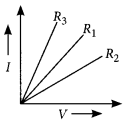
(a) R1 = R2 = R3
(b) R1 > R2 > R3
(c) R3 > R2 > R1
(d) R2 > R1 > R3
Answer:
(d) : The inverse of the slope of I-V graph gives the resistance of the material. Here the slope of -Rj is highest. Thus, R2 > R1 > R
21. . What is the critical angle for total internal reflection?
a) 90°b) 60°
c) 45°
d) 0°
b) Absorption
c) Reflection
d) Refraction
b) Dispersion
c) Reflection
d) Refraction
b) Decreases current
c) Changes current direction
d) Stores electrical energy
b) From the north pole to the south pole
c) Perpendicular to the wire
d) In circular loops around the wire
b) Ampere
c) Volt
d) Watt
b) Power = Current × Resistance
c) Power = Voltage × Resistance
d) Power = Current × Distance
b) 50 cm
c) 25 cm
d) 100 cm
b) Regulate pupil size
c) Produce tears
d) Detect light and send signals to the brain
b) Parabolic mirror
c) Convex mirror
d) Plane mirror
b) To produce a temporary magnetic field
c) To store electric charge
d) To create a constant magnetic field
b) To detect colors
c) To control the amount of light entering the eye
d) To protect the eye from dust
b) To reverse the direction of the magnetic field
c) To regulate the speed
d) To increase the current
b) +0.5 D
c) -5 D
d) -0.5 D
b) 2 ohms
c) 10 ohms
d) 5 ohms
b) +30 cm
c) -45 cm
d) +45 cm
b) 1.5 N
c) 6 N
d) 0.5 N
b) The current halves
c) The power increases
d) The power remains constant
b) 3Ω
c) 10Ω
d) 5Ω
b) Electric bulb
c) Battery
d) Capacitor
b) 10V
c) 2V
d) 5V
b) Fleming’s left-hand rule
c) Lenz’s law
d) Ohm’s law
b) Iron
c) Cobalt
d) Copper
(a) Both (A) and (R) are true and (R) is the correct explanation of the assertion (A).
(b) Both (A) and (R) are true, but (R) is not the correct explanation of the assertion (A).
(c) (A) is true, but (R) is false.
(d) (A) is false, but (R) is true.
(b)
(c) 2A
(d) 3A
(a) Both (A) and (R) are true and (R) is the correct explanation of the assertion (A).
(b) Both (A) and (R) are true, but (R) is not the correct explanation of the assertion (A).
(c) (A) is true, but (R) is false.
(d) (A) is false, but (R) is true.
(a) 2 Ω
(b) 1 Ω
(c) 2.5 Ω
(d) 8 Ω
(b) 4 Ω
(c) 8 Ω
(d) 16 Ω

No comments:
Post a Comment