Important Questions of Electricity Class 10 Science Chapter 12
(b)
(c) 2A
(d) 3A
Answer:
(c) : The resistance of a conductor of length!, and area of cross section, A is
R = ρ
where ρ is the resistivity of the material.
Now for the conductor of length 21, area of cross-section A’ and resistivity ρ.
R’ = ρ
But given, R = R’ ⇒ ρ
Answer:
For the given metal wire,
length, l = 2 m
area of cross-section, A = 1.55 × 10⁻⁶ m²
resistivity of the metal, p = 2.8 × 10⁻⁸ Ω m
Since, resistance, R = ρ
So R = (
=
We are given, the length of wire, l = 1 m, radius of wire, r = 0.01 cm = 1 × 10⁻⁴ m and resistance, R = 20Ω As we know,
R = ρ
∴ 20Ω.= ρ
∴ ρ = 6.28 × 10⁻⁷ Ω m
Given; resistivity of copper = 1.6 × 10⁻⁸ Ω m, diameter of wire, d = 0.5 mm and resistance of wire, R = 100 Ω
Radius of wire, r =
= 0.25 mm = 2.5 × 10⁻⁴ m
Area of cross-section of wire, A = nr²
∴ A = 3.14 × (2.5 × 10-4)²
= 1.9625 × 10⁻⁷ m²
= 1.9 × 10⁻⁷ m²
As, R = ρ
∴ 100 Ω =
l = 1200 m
If diameter is doubled (d’ = 2d), then the area of cross-section of wire will become
A’ = πr² = π(
Now R ∝
R’ =
Here, r = 0.01 cm = 10-4 m, ρ = 50 × 10-8 Ω m and R = 10 Ω
As, R = ρ
or l =
so l =
= 0.628 m = 62.8 cm
When wire is melted, its volume remains same, so,
V’ = V or A’l’ = Al
Here, l’ =
Therefore, A’ = 2 A
Resistance, R = ρ
Now, R’ =
So, R’ =
Percentage change in resistance,
=
(b) Three 2 Ω resistors A, B and C are connected in such a way that the total resistance of the combination is 3 Ω. Show the arrangement of the three resistors and justify your answer. (2020)
Answer:
(a) Given resistance of wire, R = 6 Ω
Let l be the length of the wire and A be its area of
cross-section. Then
R =
Now when the length is doubled, l’ = 2l and A’ =
∴ R’ =
(b) Given the total resistance of the combination = 3 Ω
In order to get a total resistance of 3 Ω, the three resistors has to be connected as shown.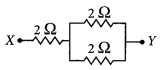
Such that,
⇒ Rp = 1 Ω
and Rs = 2 Ω + 1 Ω = 3 Ω
8. Draw a schematic diagram of a circuit consisting of a battery of 3 cells of 2 V each, a combination of three resistors of 10 Ω, 20 Ω and 30 Ω connected in parallel, a plug key and an ammeter, all connected in series. Use this circuit to find the value of the following :
(a) Current through each resistor(b) Total current in the circuit
(c) Total effective resistance of the circuit. (2020)
Answer:
The circuit diagram is as shown below.
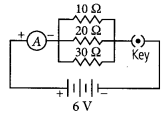
(a) Given, voltage of the battery = 2V + 2V + 2V = 6 V
Current through 10 Ω resistance,
I10 =
Current through 20 Ω resistance,
I20 =
Current through 30 Ω resistance,
I30 =
(b) Total current in the circuit, 1= I10 + I20 + I30
= 0.6 + 0.3 + 0.2 = 1.1 A
(c) Total resistance of the circuit,
=
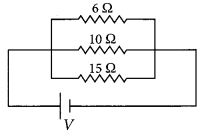
Req = 3 Ω(a) Derive an expression to find the equivalent resistance of three resistors connected in series. Also draw the schematic diagram of the circuit.(b) Find the equivalent resistance of the following circuit.
Answer:
(a) Refer to answer 37.
(b) For the given circuit,
R1 = 6 Ω, R2 = 10 Ω, R3 = 15 Ω.
As
=
Req = 3 Ω
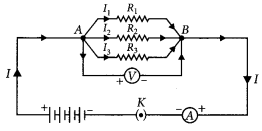
(i) The potential difference across their ends is the same.
(ii) The sum of current through them is the current drawn from the source of energy or cell.
I = I1 + I1 + I3 or
(iii) The equivalent resistance is given by,
Hence equivalent resistance in parallel combination is equal to the sum of reciprocals of the individual resistances.
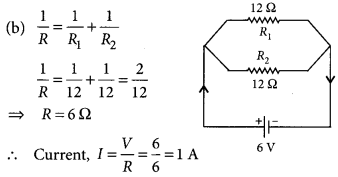
10. The resistance of a resistor is reduced to half of its initial value. In doing so, if other parameters of the circuit remain unchanged, the heating effects in the resistor will become
(c) one-fourth
(d) four times (2020)
Answer:
(a) : We know, H = I²Rt =
Now when, R’ =
H’ =

No comments:
Post a Comment